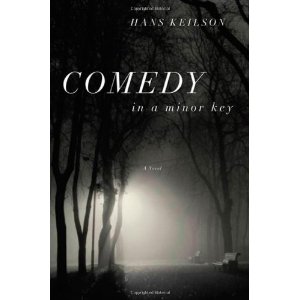
Comedy in a Minor Key by Hans Keilson


Written in 1947 by Hans Keilson, this German novella, translated brilliantly by Damion Searls, is a quick little read that will stick with you for quite some time. The story is simple: Wim and Marie, a Dutch couple, take the decision to hide a Jew called Nico in their home. Although the trio is faced with an extraordinary situation, they endeavor to keep life as ordinary as possible.

Until Nico unexpectedly dies.

I didn’t give anything away there; you find out about his death in the first few pages. But Wim and Marie must now deal with his body, and therein lies the ‘comedy’ mentioned in the title. I must warn you, though: you’ll only laugh if you find the cosmic sense of humor funny.

There’s a lot in this novel for a book club to discuss, but most of it will be quite heavy. If your group is up for an existential journey, then it could be a good choice. If not, I still highly recommend this book for any individual reader–it really makes you stop and think about life and its meanings, or lack thereof. For a more in-depth and wonderful review by Francine Prose of this and Keilson’s other work, The Death of the Adversary, click here: http://www.nytimes.com/2010/08/08/books/review/Prose-t.html


Literary Masters has a Facebook page. I say this with mixed feelings. I hate it when people of my generation (not that old, just not that young either, never mind the specifics) act disdainful toward the current craze of social networking and all that entails, you know, Facebook, Twitter and the like. Instant info, constant sharing, keeping it short, what’s the buzz now. I’m not against any of it, I just wonder about the value of it all. And I wonder, where is it taking us?

I mean, after all, I run book groups and literary salons. We’re kind of the antithesis of what I’ve just described. We take time to read books. We take time to think about what we’ve read. We take time to ‘dig deep’ into what we’ve read and we take time to discuss what we’ve read.

And I think every single person in every one of my groups would tell you that there is tremendous value in what we do. Not only do we connect with each other every month, we connect with readers across time, we reflect on what it means to be on this earth, and we contemplate how we want to live.

Hmm…that was a bit heavy.

Having said all that, I agree with Tracy from the musical Hairspray, who sings, “You can’t stop an avalanche when it’s racing down the hill,” and so I am, better late than never, going to embrace my new Facebook page. I’m not sure where it’s leading me, but I’m curious. So, I plan to update it frequently. Go there today and you’ll find a last minute gift suggestion–one of the funniest books I’ve read all year.

So please visit Literary Masters on Facebook. And let me know if you “like” it!

The Writers’ Block at KQED


KQED, the San Francisco Bay Area affiliate of NPR, contacted me to say that Nicole Krauss, author of Great House, the novel I blogged about here, recently read from her book on KQED’s weekly reading series “The Writers’ Block.”

KQED thought my “readers at Stick With Lit might be interested.” Thanks so much, KQED!

Readers, let me know what you think. You can find the episode here:

http://www.kqed.org/arts/programs/writersblock/episode.jsp?essid=38566

You can also embed the reading – you’ll find the code to the right of the
audio player.

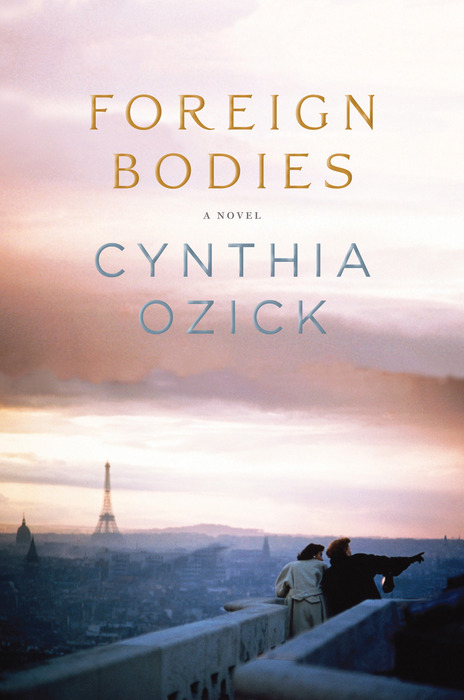
Foreign Bodies by Cynthia Ozick

This was my first introduction to Cynthia Ozick. I read two reviews of Foreign Bodies; both said it was a clever re-working of Henry James’ The Ambassadors, and both assured me that one could read, understand, and enjoy the former without having read the latter.

So, I read and enjoyed Foreign Bodies in a couple of days. Did I understand it? Hmm…I think so. Although I must admit, I feel like I’m missing… something.

Quick plot summary: It’s 1952 and Marvin Nachtigall has asked his sister Bea to interrupt her European vacation in order to locate Marvin’s wayward son Julian and make him return to his studies in America and the life Marvin feels he should lead.

Bea does as she is asked, sort of. Resenting her horrid brother’s presumptive attitude (and he really is horrid), she does locate Julian, now living in Paris with his older and traumatized wife, a Romanian refugee, but she makes little effort to repatriate him. Instead, she takes matters into her own hands.

Bea, who has been virtually absent from her brother’s adult life and the lives of his children, now interacts not only with Julian, but also with Julian’s narcissistic sister Iris and their mother Margaret, who has been shunted off for a stay at an asylum. (Evidently she can’t take the strain of missing her son for so long, but the reader understands that she must really want to escape her horrid husband.) Bea also interacts, not only through memories but also in reality, with her former husband, Leo, another semi-horrid person.

Interacting is big for Bea, because she hasn’t done much of it (that the reader can see) up until now. A life passing one by, or living the life that others have chosen for you, or being an observer of the lives of others–are all themes running through this novel, and Bea falls into all three categories. Until now. Now Bea asserts herself, and the consequences are…startling.

I liked this book, or I should say I liked Ozick’s writing. It’s sparkling. And inventive. And captivating. It kind of dazzles. However, I can’t help feeling that I came away from the book with an appreciation of the surface of the story, but not the depths. As horrid as many of the characters were, I wanted to know more about them, and maybe in not such a clever way as Ozick delivers them.

Somehow I feel (and I could be wrong) that if I read The Ambassadors, I just might gain greater access to Foreign Bodies. Or perhaps I should have the members of my Literary Masters book groups read it, and together we can “dig deep” into it and see just what kind of literary gem we have unearthed.

What about you? Have you read Foreign Bodies? What do you think about it?

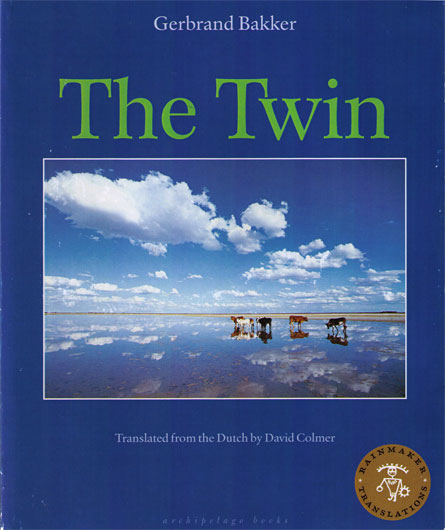
The Twin by Gerbrand Bakker


The Twin by Gerbrand Bakker first came to my attention as I sought recent prize-winning novels for my Literary Masters book groups to read. The Twin won the International IMPAC Dublin Literary Award for 2010. I read a couple of bloggers’ reviews and the book sounded a tad slow and dull, not something that would appeal to my members. My library doesn’t carry it, and I never saw it in any book store, so it sort of fell off my radar.

Then one day recently I visited a local school’s book fair and there it was. And it just looked so…inviting. I know that’s silly. I mean, I’ve blogged about whether one should judge a book by its cover, but there was something about the aesthetics of this book that compelled me to buy it.

I’m so glad that I did.

I felt like I escaped into a different world while I read this book. The prose is spare but so captivating, I had a hard time putting the book down and looked forward to curling up with it whenever I had the chance.

The setting is a farm in Holland that seems to have escaped the progress of time. Helmer, the narrator and son who lives on the farm with his now dying father, seems to have missed the progress of time, but not of his own choosing. We find out that Helmer is the surviving twin of Henk, who died twenty years previously in an accident caused by his then fiance, Riet. Banished from the family, Riet hasn’t been heard from in twenty years. Out of the blue, she contacts Helmer to ask if he will take on her somewhat troubled son, also named Henk, as a farm-hand. Young Henk comes to stay for awhile, and the reader now not only spends time with Helmer, his dad, and the young Henk, but also encounters the many ghosts that Helmer conjures as he shares his memories.

The thing about this book is that the writing makes it seem like there’s nothing going on; the daily life as described by Helmer, the narrator, isn’t exactly exciting. He tells us about his redecorating the house, taking care of the farm animals, interacting with the few people he comes in contact with.

And then every so often, something happens–something significant–and the reader realizes that there is a whole heck of a lot going on. The writing is so subtle, though, the depth of the story as well as the depth of the characters can be missed. You know by now that when I read a book I always have my book groups in mind. Will the members find it fascinating? Does it lend itself to a good discussion? Well, I can’t say the tone and pace of the book are for everyone, but there is plenty there to “dig deep into.”

There is emotion and feeling pulsing beneath the restraint of the surface–of both the writing and the characters. And there’s plenty of metaphors sitting there just waiting to be ‘dug into’ by a book group. Clocks, crows, the rooms of the house and other spaces, are just a few.

I look forward to reading this book again so I can glean more than I did the first time. And I know I’ll enjoy re-reading it; it’s just that pleasurable.

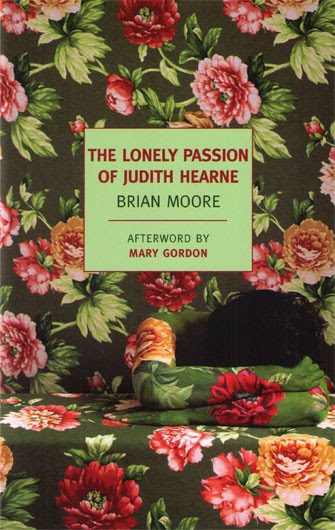
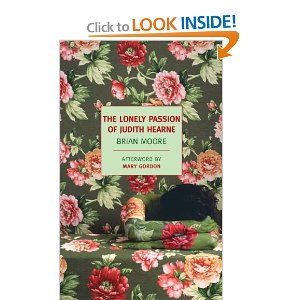
The Lonely Passion of Judith Hearne by Brian Moore


I loved this book! I sat down and practically finished it in one reading. Written in 1955, it tells the story of Judith Hearne, a woman with a limited life view, a rigid code of behavior, an imagination that often supplants reality, and a wicked secret that threatens to destroy her.

Judith has done the right thing, much to the detriment of her own happiness. Caring for her dying aunt, Judith has missed out on life. No husband, no job, no opportunities. But she has a way of coping. Well, more than one way, but I don’t want to give too much of the story away. Suffice to say, and this is what I loved about this book, one way she copes is by imagining an alternative reality. And she does it so subtly (Moore’s writing is so brilliant) that you go along with her, thinking it’s real until you realize, hold on, she’s got it all wrong. However, by that time you can see just how and why her fantasies would have carried her so far; after all, you’ve been carried along as well. Moore makes Judith such a pitiable character, not only do you allow her those fantasies–you wish for them to come true.

I finished this book and put Brian Moore on my list of authors that I must read more of. His writing immediately carried me to a place and time that I now feel I know intimately. This book is a winner–run, don’t walk, to your bookstore and enjoy it!

Great House by Nicole Krauss


Thanks for all your emails and phone calls; I am doing just fine, thanks. The reason I’ve not blogged in a while is that I’ve been reading! As you know, my Literary Masters Book Groups’ selected book for this coming February has not yet been announced. I purposely left that month open so I could choose a red-hot-just-won-the-award prize-winning novel. After all, this time of year is quite exciting; we have the Nobel in Literature, the Man Booker, and, days away, the National Book Award.

The book I’m blogging about today–Great House by Nicole Krauss–is a finalist for the National Book Award. I read a great review of this novel, and I love last year’s National Book Award Winner, Let the Great World Spin, by Colum McCann. You know I love that book–it’s this month’s selected novel!

But back to Great House. I am so torn about this book. I feel like the author wrote the book on a pile of cards, shuffled the cards, dropped the cards, picked them and shuffled them some more, then published the book. I get the post-modern literary thing, really, I do, but I just kept thinking while reading this book, did she have to make it this so bloody difficult to follow? Is the structure carrying some meaning to me as reader?

The different chapters or sections of the book are mirror-imaged against each other, with the center (or roof if you like an image of a house) being “Lies Told by Children.” The chapters are tied together through the seemingly disparate characters and a certain significant desk, although I can understand an impatient reader missing the connections altogether. I confess, I finished the book–and believe me, I read this book carefully–and I am still wondering who was related to whom and who did what. I think the lies (referred to above in the chapter title) are actually told by the father, not the children, but I’m not sure.

There are certain books with a complicated structure whose writing is so beautiful it pulls you through the difficulty of the plot and in the end you realize that the structure of the story is indeed perfect to its whole. I’m thinking of The English Patient, for example. And Let the Great World Spin, while not having an extremely complex structure, still demands a certain amount of attention from the reader to make all the wonderful connections between the ostensibly separate chapters. But McCann’s writing is so poetic, the effort that the reader makes is a pleasurable one.

I’m sorry I can’t say the same for Great House. Perhaps a second reading with illuminate a lot for me, but I’m not sure I want to spend my time re-reading it. On the one hand, I’d like my book groups to read it, so we can all figure it out. On the other hand, I’m not sure I want to subject my members to such a task.

I’m going to wait for the National Book Awards announcement this week. Should Great House win, I’m sure lots of people will write about it, and perhaps I can glean something from what they say. Perhaps even Nicole Krauss will shed some light on her work. So, stay tuned. Perhaps there’s more to come.

Freedom by Jonathan Franzen


My personal book club discussed Freedom by Jonathan Franzen last night. I was at a disadvantage; having read it three weeks ago, I couldn’t remember too many details–like plot, for example. You all know by now that my memory is abominable. You know what, though? Another member, let’s call her Barbara, was railing against the conventional wisdom that Freedom is the new Great American Novel. And she said that although she enjoyed it, it was not memorable in any way whatsoever. So perhaps it’s not my memory at fault here. Perhaps I’ve forgotten about Freedom largely because it’s…forgettable.

This is not to say that it’s not a romping good read. I found that I was looking forward to curling up with it each night; it’s very compelling. However, although I think it is fantastically popular because it zeroes in on and illuminates our zeitgeist in a brilliant fashion, I still found it lacking in any profound message or moment of sublime art. I wasn’t, in a word, moved.

My book club colleagues didn’t even like the book as much as I had. They found it dark, dark, dark, and they got sick of the extreme self-absorption of the characters. Barbara found it structurally flawed; she didn’t find any part of it believable, and she didn’t like that it seemed to slip in and out of being satirical–almost like it couldn’t decide what it was.

Another member, let’s call her Elizabeth, said she found the sex in the book appalling, and it had to have been Jonathan Franzen’s fantasies working their way out there. No woman would have written the sex scenes as he did. I won’t detail our conversation surrounding this issue, but Elizabeth had us in stitches laughing.

The characters weren’t likable (not that they should be), but some of us didn’t even find them realistic. The cad of the story, Richard, aka Dick for the obvious reasons, was the only honest one, we decided. Lots of smothering-type relationships going on; we liked that Joey resented his mother for smothering him, so he married someone who was the antithesis of her. Even if his wife was bizarrely self-effacing. Oh, was Joey really in love with his wife’s mother? Remember the MILF reference?

Anyway, if you want the plot you can go onto one of the hundreds (it seems) stellar reviews of this novel. We did wonder if there is a bit of group-think going on with the critics when it comes to this book, by the way. Oprah? Really? But now it’s been snubbed by the National Book Award powers-that-be, so maybe not. Back to plot, suffice to say here that it is, in my book club’s humble opinion, overly ambitious and would have been better if Franzen had not thrown in the kitchen sink, if you know what I mean.

I did really enjoy one gem of discovery that I’d like to share with you. I read Corrections years ago and the only scene I remember has to do with I think it’s the father who is suffering from Alzheimer’s flinging around his poop. Or dreaming about it or something. Anyway, there was a lot of poop in the scene. And now in Freedom, there is the scene where Joey has to dig through his poop to retrieve the wedding ring he has swallowed. What’s up with that? Could this scene in Freedom be a metaphor for the shit (pardon the vulgarity) that everyone has to go through in a marriage in order to retain the relationship? Could we go further and say it’s a metaphor for the shit everyone has to go through in life in order to grab the golden ring?

You decide as you read it. For it really is, notwithstanding the above comments, worth reading!

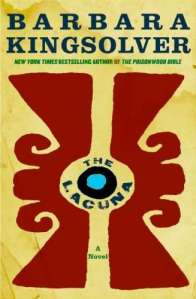
Wrapping Up The Lacuna by Barbara Kingsolver


Well, this was not an easy read, and some members couldn’t stick with the book; I understand–Kingsolver is not for everyone. However, most of us loved The Lacuna. We liked that it is such a rich novel–there are so many layers to it and so much to discuss. And we even made an attempt to look at the novel through some lenses of literary theory: New Criticism, Cultural Criticism, and Post-colonialism.

Some of the members’ insightful comments that I want to highlight here (these are almost bullet points because I am short on time–I have to move on to The Picture of Dorian Gray–and go to the grocery store!):

A big part of what this book is about is voice. Harrison has to find his and he does so by giving a voice to the “mute culture” of the ancient Mexicans. However, his own voice is then silenced by the howler monkeys–the press–as he refuses to answer or respond to their claims of ‘fact’ and their allegations against him. His silence here got us talking about the public vs private person of a writer or other notable. Just how much does a writer owe his/ her readers? Harrison’s voice, through his words, are refused an audience as the public turns against him, but in the end, his voice, through the words of Violet Brown, are written down–and survive.

Voice leads to words and language and we all talked about the power of language and how it can create a ‘reality’ that is then taken for fact, but isn’t necessarily ‘real’ or ‘true.’ Or perhaps isn’t the entire story. This led into a discussion of perspective.

Even the structure of the book, a mix of journal, memoir, clippings, and more, seems to shout out that there are different angles from which to view something or someone. Which led us into a discussion about what truth is–is there such a thing, or is it just a perspective? Or is it a consensus of perspectives?

This led us into a discussion of the lacuna–the missing part to the story. Well, there were a lot of lacunae that we discussed. For example, one member saw the lacuna as an empty space to be given definition by others. And tied this to the identity of Harrison.

Other members saw the lacuna as a void or abyss. A scary, potentially fatal place to pass through and come into a sort of rebirth on the other side. We tied this to the birth of identity of Harrison when Frida sent him his notes and papers–when he could then become a writer.

Some members saw the lacuna as a gap to be filled–the missing part of the story–and tied this to what the press does when they don’t know the full story–they just fill it in with whatever they want.

Which then got us talking–isn’t there always more to the story? Can we ever know all there is to know about someone or something?

We also talked about the gap as what we fill in as readers–it’s the space of interpretation between what is said and what isn’t.

We all loved the howler monkeys–and we talked about the game of telephone–one person tells another who tells another and by the end of the chain–gossip, rumor, innuendo becomes fact, becomes reality, becomes truth and history.

One member brought up the fear that is pervasive in the book–Harrison’s fear, the public’s fear, the fear of those times, the fear of our times.

And we talked about history. Everyone agreed that the book was saying that history repeats itself–so watch out! Many of us found this to be depressing, but one member said, no, there is a hopeful message that we can get off this runaway train of history through art. I really love thinking about this…

We talked about art and politics and I look forward to more discussions about art as the season progresses. Does art, and this includes literature, have an obligation to be political? Or is it political without even trying to be? Can you separate politics from art?

Many of us agreed that this novel is an indictment of the press and of group-think. An indictment of taking what others have told us for fact and not looking deeper ourselves for the missing parts. And then, interestingly, we talked about how this novel is just another source of information that we need to consider in the context of its missing parts. Kingsolver can be pretty heavy-handed politically, and isn’t she doing the exact same thing that she is criticizing others for doing? Isn’t she only telling part of the story, her version of the story? Yet again, can you ever tell the whole story? Isn’t there, as we asked above, always more to the story? Isn’t there always another lacuna?

We talked about flatness of the characters, especially Harrison, and agreed that he is really a vehicle to get the points of the story across to us, and to take us on a journey through history. Many didn’t like the book because they couldn’t warm up to the characters, and one member said she absolutely hated the novel and thought it was absurd. Most everyone enjoyed reading about Frida and Diego–how could you not?

We talked about lots more, but I’m going to wrap this up right now and let YOU weigh in and POST A COMMENT. Tell me what I’ve forgotten, tell me your thoughts, tell me whatever you like!

Man Booker Short List Announced


Six novels have made the short list cut for the prestigious Man Booker Award. Here’s the link if you would like to know more:

www.themanbookerprize.com/news/stories/1451

I am bummed that The Thousand Autumns of Jacob de Zoet, our :Literary Masters book groups choice for May, didn’t make the list. I do have one of the short listed books sitting on my ‘To Be Read’ shelf: Parrot and Olivier in America by Peter Carey. He’s already won the prize twice, so there’s a lot of hoopla about whether he can pull a hat trick. I’m not a big fan of his, which is one of the reasons I haven’t yet read this latest one. Perhaps I’ll give it a go soon.

Room, which I blogged about a couple of posts below (but you knew that, right?) made the cut and is apparently one of the favorites. I still don’t want to read it.

The Long Song by Andrea Levy made the list. Now I read this book recently and really enjoyed it. It’s a story told by a Jamaican slave and her voice is humorous, touching, and incredibly unique. I’ve been thinking about using this book for the month of February’s Literary Masters book groups. Hmmm…

The winner of the prize will be announced October 12th. Until then, we can all hold our breath. How about you? Have you read any of the books on the short list?